 Save to Pinterest
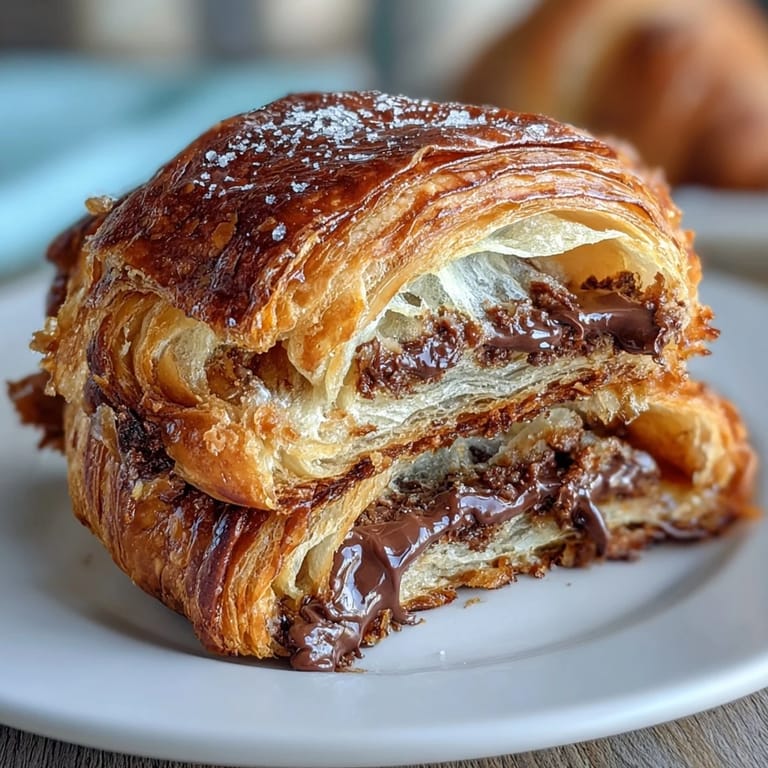
 There's a particular morning I won't forget: standing in my kitchen at dawn, watching steam rise from fresh croissants while my sourdough starter bubbled contentedly on the counter nearby. I'd been curious whether that tangy, living culture could transform ordinary laminated dough into something extraordinary, and the moment I bit into one—that crackling exterior giving way to butter-soaked layers infused with dark chocolate—I knew the experiment had worked. These aren't your typical French croissants; they carry the subtle complexity of sourdough, a whisper of fermented depth that makes each bite feel both familiar and entirely new.
I made these for a friend who'd just moved into a new place, and I'll always remember her sitting at her bare kitchen table, surrounded by boxes, just closing her eyes and eating one slowly. She didn't say much, just nodded, and I realized that sometimes feeding people something you've spent hours crafting is its own kind of welcome. That batch became the unofficial housewarming gift, and she still asks when I'm making them again.
Ingredients
- Bread flour (500 g): Use a flour with decent protein content; it gives structure to hold all those butter layers without deflating.
- Active sourdough starter (100 g at 100% hydration): This is your secret ingredient—make sure it's recently fed and bubbly, with that slightly sour aroma that means it's ready to work.
- Cold whole milk (220 ml): Cold milk slows fermentation slightly, giving you better control and more developed flavor.
- Granulated sugar (60 g): Just enough sweetness to let the chocolate shine and feed the fermentation without overwhelming the savory notes.
- Fine sea salt (10 g): Don't skip this; salt strengthens gluten and balances the chocolate beautifully.
- Unsalted butter (30 g for dough, 250 g for laminating): European-style butter for laminating has a higher fat content, which creates those impossibly flaky layers—it's worth seeking out.
- Large egg (1): For egg wash, which gives that deep golden burnish and helps croissants brown evenly.
- High-quality dark chocolate (120 g, 60% cocoa minimum): This is where you shouldn't compromise; cheap chocolate becomes bland and greasy, while good chocolate melts silkily and tastes like actual chocolate.
Tired of Takeout? 🥡
Get 10 meals you can make faster than delivery arrives. Seriously.
One email. No spam. Unsubscribe anytime.
Instructions
- Mix your dough foundation:
- In a large bowl or stand mixer, combine flour, sourdough starter, cold milk, sugar, salt, and softened butter. Mix until everything comes together into a shaggy mass, then knead for 4 to 5 minutes until the dough feels smooth and slightly elastic, no longer sticky. Cover and let rest at room temperature for 30 minutes while you take a breath and drink some coffee.
- Bulk ferment slowly:
- Place dough in a lightly oiled bowl, cover loosely, and let it bulk ferment at room temperature for 2 to 3 hours, performing two gentle stretch-and-folds at 1-hour intervals (this builds strength without overworking the dough). Then refrigerate overnight for 8 to 12 hours, letting the sourdough do its slow magic and flavors develop.
- Prepare your butter block:
- Place cold European-style butter between two sheets of parchment paper and pound it gently with a rolling pin until it's pliable, then roll it into a 20 × 20 cm square. Refrigerate until it's firm but not hard—you want it to bend slightly without cracking when you fold dough around it.
- Laminate with patience:
- On a floured surface, roll your cold dough into a 30 × 30 cm square, place the butter block in the center, and fold the dough corners over to encase it completely. Roll out to a 60 × 20 cm rectangle, then perform a letter fold (fold into thirds like a business letter). Chill for 30 minutes, then repeat this rolling and folding process two more times, chilling between each turn—this is where the magic happens, layer by golden layer.
- Shape with chocolate treasures:
- Roll your final laminated dough to about 4 mm thick in a 60 × 30 cm rectangle and cut into 12 long triangles with a base of about 10 cm. Place one chocolate baton at the wide end of each triangle and roll tightly toward the tip, sealing the point gently so chocolate doesn't escape during baking.
- Proof until puffy:
- Place shaped croissants on parchment-lined baking sheets, cover loosely with a kitchen towel, and let them proof at room temperature for 4 to 5 hours until visibly doubled in size and jiggly when gently nudged. If your kitchen is cold, find a slightly warm, draft-free spot (a closed oven with the light on, or near a sunny window) to encourage rise.
- Egg wash and bake:
- Preheat your oven to 200°C (400°F), whisk one egg with 1 tablespoon water, and gently brush each croissant with this egg wash—not too heavy, just enough for shine and color. Bake for 18 to 22 minutes until they're deep golden brown and sound crisp when you tap the bottom.
- Cool and contemplate:
- Transfer to a wire rack and let cool for at least 15 minutes before eating (I know it's hard). This lets the interior set so you get that satisfying crunch without burning your mouth.
 Save to Pinterest
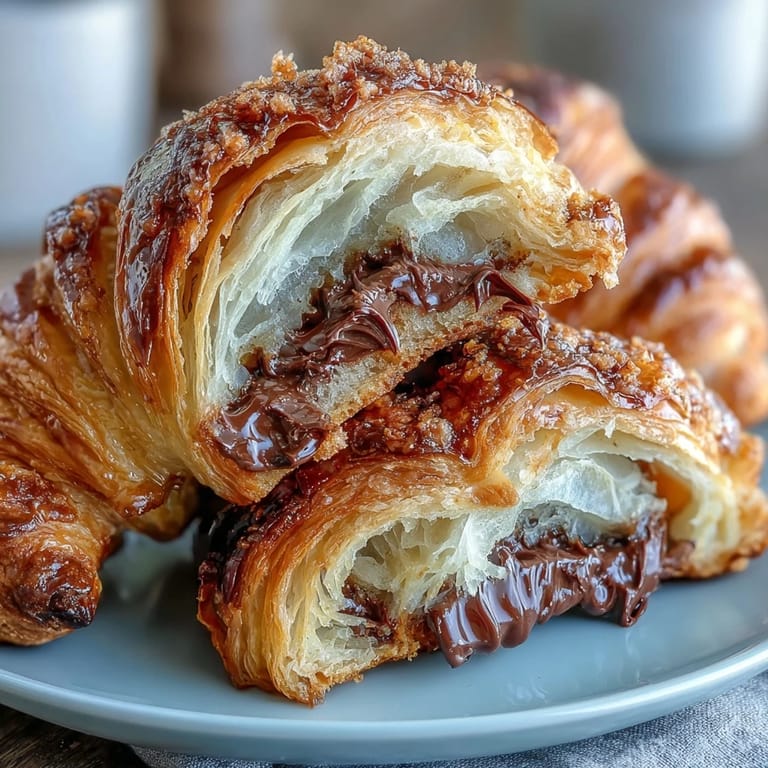
 One afternoon, my partner came home during the final proof, saw all 12 croissants lined up on the counter looking puffy and beautiful, and just laughed—because I'd spent the entire day on them, flour everywhere, and suddenly understood why French pastry chefs treat lamination like a sacred art. These croissants stopped being just breakfast; they became evidence that time, care, and sourdough culture could create something that tastes like it came from a Parisian bakery window.
The Sourdough Advantage
Using sourdough starter instead of commercial yeast changes everything about the experience and the result. The fermentation happens more slowly, which means deeper flavor development and better digestibility, but it also means this project spans nearly two days—there's no rushing it. I actually appreciate that constraint; it forces you to plan ahead, to respect the process, and to understand that good things rarely happen fast.
Lamination Isn't Magic
The first time I laminated dough, I was convinced I'd fail because the butter seemed too cold or too warm or somehow wrong, but the truth is simpler than that: you're just folding butter into dough repeatedly until thousands of thin layers form. Each fold creates two more layers, so by your third turn, you've got hundreds of butter-dough boundaries waiting to steam and puff and separate into that signature flakiness. The moment you understand it's just geometry and patience, not witchcraft, you realize you can actually do this.
Chocolate Selection and Storage
High-quality dark chocolate matters more here than in many recipes because it's not being whipped into a buttercream or melted into a sauce—it's a distinct, concentrated flavor experience in every bite. Look for chocolate that lists cocoa butter as an ingredient and has a clean snap when you break it; cheaper chocolate often contains vegetable oils and tastes waxy by comparison. Once baked, these croissants are best eaten the same day while they're still crisp, though you can store them in an airtight container for a day and gently reheat them in a 160°C oven for 5 to 7 minutes to revive the crispness.
- If you want to make croissants ahead, freeze the shaped, unproofed croissants and proof them directly from frozen, adding about 2 extra hours to the final proof time.
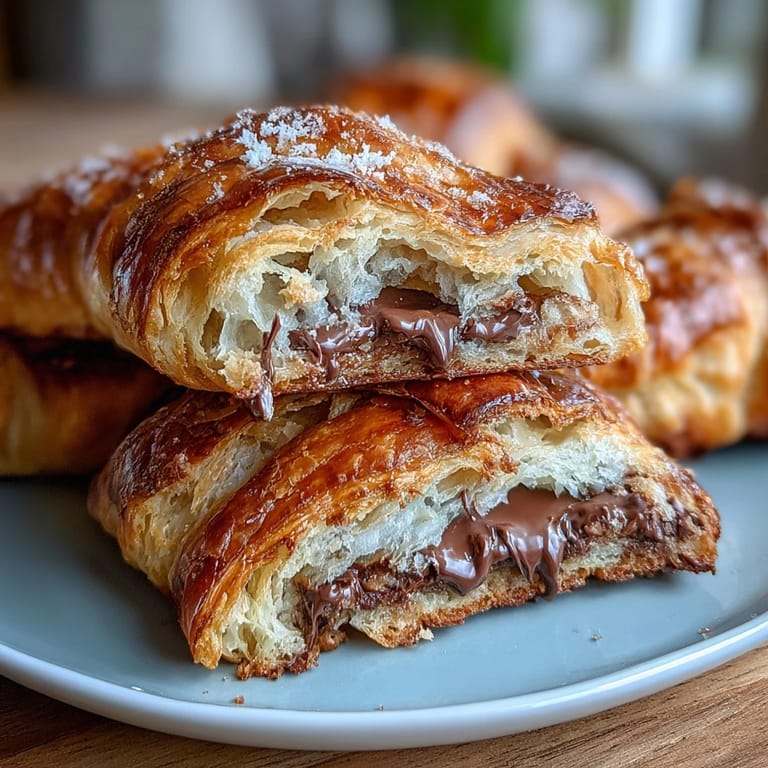
- A sprinkle of flaky sea salt on top before baking adds sophistication and makes the chocolate taste even more intense by contrast.
- Orange zest stirred into the dough creates a subtle citrus note that brightens the sourdough tang without competing with the chocolate.
 Save to Pinterest
 Making sourdough croissants taught me that ambitious baking is less about talent and more about showing up, paying attention, and trusting the process—and that's a lesson worth learning even if you only make them once. I hope your kitchen smells as good as mine did.
Common Recipe Questions
- → What type of flour is best for sourdough croissants?
Bread flour is ideal as it provides the necessary gluten strength for structure and layering during lamination.
- → How does laminating affect the croissant texture?
Laminating folds butter into the dough multiple times creating delicate, flaky layers that give croissants their signature crispness.
- → Why is chilling important during preparation?
Chilling firms the butter and relaxes the dough, preventing melting and helping maintain distinct layers for optimal flakiness.
- → What cocoa percentage works best for the chocolate filling?
Dark chocolate with at least 60% cocoa content balances rich flavor and smooth melting inside the croissants.
- → Can these croissants be reheated without losing texture?
Yes, gently reheating in the oven helps refresh the crisp exterior while preserving the tender interior layers.
- → What causes the croissants to have a tangy flavor?
The active sourdough starter imparts a subtle tang, adding depth that complements the buttery richness and chocolate.